Templates are pre-approved messages you can send outside the 24-hour window. WhatsApp reviews the wording before you can use it, which usually takes minutes but can take up to a day.
You do not have to write them twice
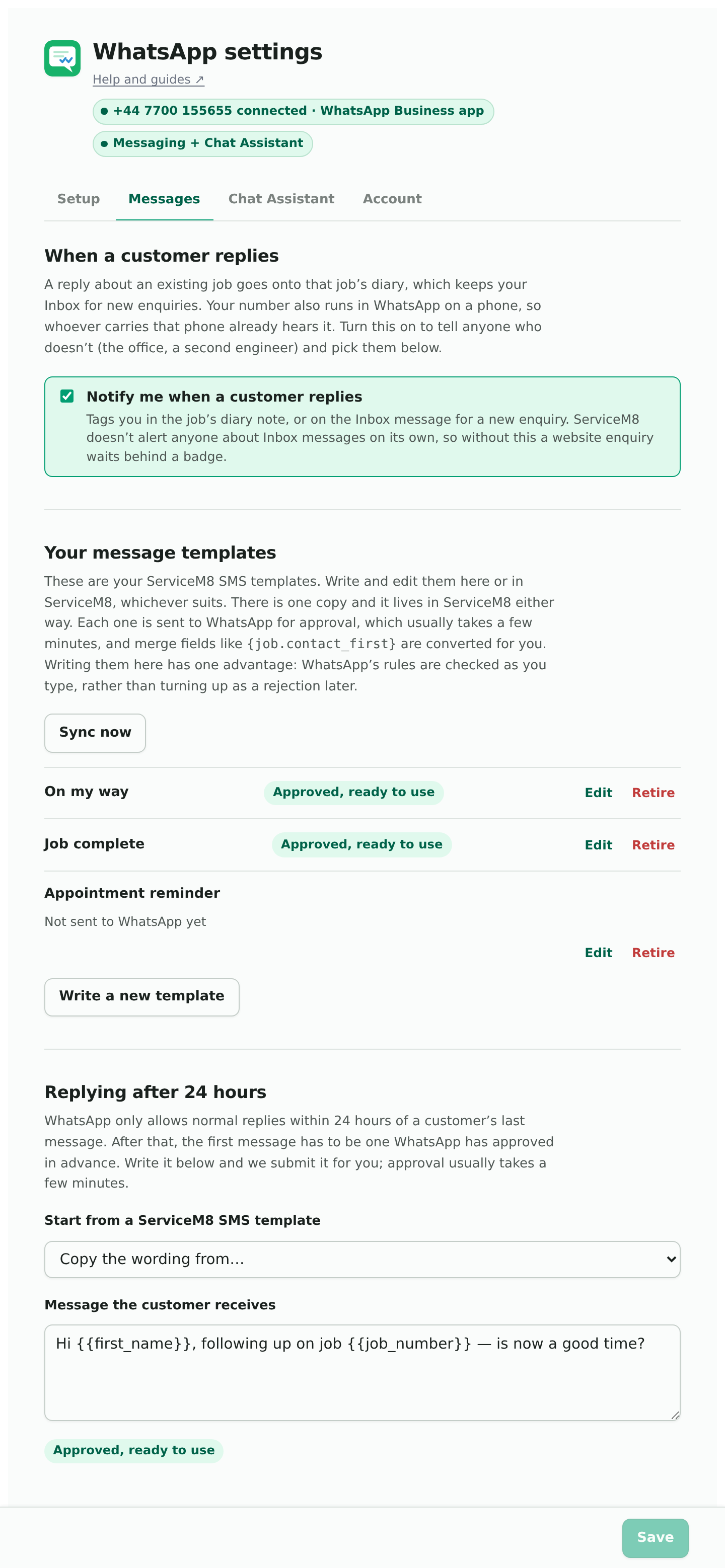
The add-on mirrors the SMS templates you already have in ServiceM8. It converts them to WhatsApp’s format, submits them for approval, and keeps them in step when you edit or delete the ServiceM8 original. There is one copy and it lives in ServiceM8 either way.
Your merge fields come across. When you send one from a job, the values are filled in from that job, the customer’s name, the job number, your business name, exactly as they would be in an SMS. Which fields convert.
You can also write and edit them from inside the add-on, in the Messages tab, which checks WhatsApp’s rules as you type rather than after you submit. The editor has an Insert a detail from the job menu so you pick the field rather than remembering how it is spelt.
The “replying after 24 hours” message
Further down the Messages tab is one template that matters more than the others: the message you send to reopen a conversation once the window has closed. Write it in the box, or start from one of your SMS templates, and we submit it for you. The chip beside it shows Pending, Approved or Rejected.
If you already have a template approved in WhatsApp Manager that you would rather use, open Use a template you have already had approved and give its name and language code.
If a template is rejected
The Messages tab says why, in plain English. The common reasons:
- It starts or ends with a merge field. WhatsApp does not allow it. Put a word before or after: “Hi {job.contact_first}” rather than the field on its own.
- It reads as marketing rather than information about a job. WhatsApp is strict about this and the line is not always where you would put it.
- INVALID_FORMAT in an email from Meta. This was a fault of ours in the first weeks, since fixed. If you see it now, email us rather than rewriting the template.
Fix the wording and resubmit. A rejection costs nothing but time.
Utility and marketing
WhatsApp sorts every template into one of two categories, and it matters because they cost different amounts. The add-on reads your wording and picks the category for you.
- Utility: about a job the customer already has with you. Cheaper.
- Marketing: promotional. Costs more, and customers can switch it off entirely.
If WhatsApp decides one of your templates is really marketing when you meant it as utility, the add-on tells you. That is worth knowing rather than discovering on a bill, because it changes both what it costs and whether it arrives at all.
A note on editing
Editing an approved template sends it back for approval, and it cannot be used while it is being reviewed. If a template is one you rely on, think of an edit as taking it out of service for a bit, usually minutes, occasionally a day.